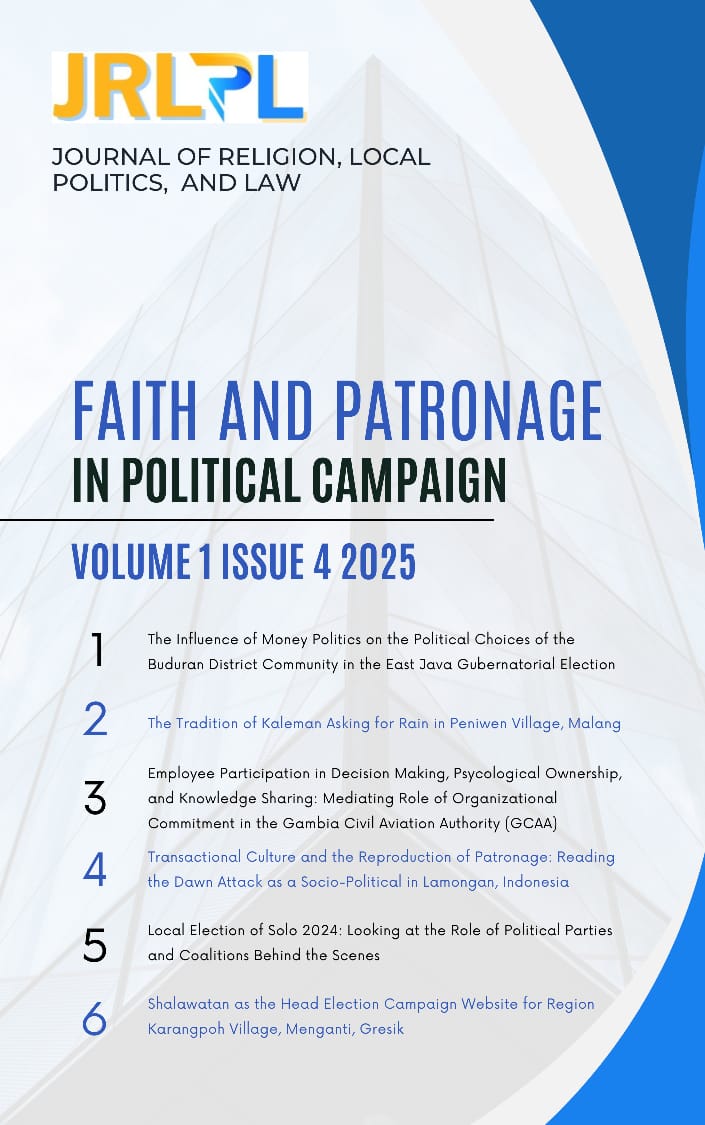
Employee Participation in Decision Making, Psychological Ownership, and Knowledge Sharing: Mediating Role of Organizational Commitment in The Gambia Civil Aviation Authority (GCAA)
Authors
-
Muhammed Bah
 Muhammadiyah University Yogyakarta
Competing Interests
Muhammadiyah University Yogyakarta
Competing InterestsInternational
-
Meika Kurnia Puji Rahayu
 Universitas Muhammadiyah Yogyakarta, Yogyakarta
DOI:
https://doi.org/10.64595/jrlpl.v1n4.p264-288Keywords:
Employee participation in decision-making, psychological Ownership, organizational CommitmentAbstract
This study investigates how employee participation in decision-making and psychological ownership influence knowledge sharing, with organizational commitment as a mediating factor in the Gambia Civil Aviation Authority. Addressing knowledge management challenges and limited empirical research in The Gambia, it explores how engagement and ownership enhance knowledge sharing through stronger commitment. Using a quantitative approach, structured questionnaires were distributed to staff, and data were analyzed through structural equation modeling to test direct and mediated relationships. The results show that both participation in decision-making and psychological ownership significantly and positively affect organizational commitment and knowledge sharing. Furthermore, organizational commitment enhances knowledge sharing and mediates the effects of participation and ownership. These findings highlight the importance of involving employees in organizational decisions and fostering a sense of ownership to overcome barriers to knowledge sharing. Practically, the study suggests that the Gambia Civil Aviation Authority and similar organizations should adopt participatory management and psychological empowerment strategies to build commitment and promote continuous knowledge sharing. Such efforts are vital for operational efficiency, innovation, and sustainable growth. Overall, this research fills a gap in knowledge-sharing studies within African aviation contexts and provides a framework for improving information exchange in resource-limited settings.
Downloads
References
Asatryan, V., Slevitch, L., Larzelere, R. E., & Morosan, C. (2013). Effects of Psychological Ownership on Students ’ Commitment and Satisfaction. October. https://doi.org/10.1080/10963758.2013.850294 DOI: https://doi.org/10.1080/10963758.2013.850294
Baykal, E., & Bayraktar, O. (2022). Green human resources management : A novel tool to boost work engagement. DOI: https://doi.org/10.3389/fpsyg.2022.951963
Burton, N., & Culham, T. (2021). Spiritual Practice and Management Education Pedagogy : Exploring the Philosophical Foundations of Three Spiritual Traditions. https://doi.org/10.1177/1052562920945739 DOI: https://doi.org/10.1177/1052562920945739
Chien, M. T. K. C. J. (2012). The factors impacting knowledge sharing intentions : the theory of reasoned action perspective. 89, 1479–1491. https://doi.org/10.1007/s11135-011-9462-9 DOI: https://doi.org/10.1007/s11135-011-9462-9
Culpepper, R. A., Gamble, J. E., & Blubaugh, M. G. (2004). Employee stock ownership plans and three-component Commitment. 155–170. DOI: https://doi.org/10.1348/096317904774202126
Dirik, D. (2016). KNOWLEDGE AS AN OBJECT OF PSYCHOLOGICAL OWNERSHIP AND.
June 2014.
Elele, J., Fields, D., & Beach, V. (2010). Participative decision making and organizational Commitment: Comparing Nigerian and American employees. 17(4), 368–392. https://doi.org/10.1108/13527601011086586 DOI: https://doi.org/10.1108/13527601011086586
Ghosh, S., & Swamy, D. R. (2014). OPEN ACCESS A Literature Review on Organizational Commitment – A Comprehensive Summary. 4(12), 4–14.
Giermindl, L. M., Strich, F., Christ, O., & Leicht-deobald, U. (2022). The dark sides of people analytics : reviewing the perils for organisations and employees. European Journal of Information Systems, 31(3), 410–435. https://doi.org/10.1080/0960085X.2021.1927213 DOI: https://doi.org/10.1080/0960085X.2021.1927213
Goyal, K. (2024). The Influence of Psychological Ownership ( PO ) and Organisational Citizenship Behaviour ( OCB ) on Employee Engagement : The Mediating Role of Perceived Organisational Support ( POS ) ® p İ yw psychologii w İ asno ŝ ci ϼ ◻ O Ͻ i organi Ə acy Ĥ nych Ə achowa ij o æ ywatels ħ ich ϼ O Ͻ na Ə aanga ƒ owanie pracowni ħĻ w : po ŝ rednic Əà ca rola postr Ə eganego wsparcia organi Ə acy Ĥ nego ϼ ◻ O ◻ Ͻ. 22(2), 4–27. DOI: https://doi.org/10.7172/2956-7602.104.1
Grego-planer, D., Gadomska-lila, K., & Żurek, M. (2023). THE LINK BETWEEN PERCEIVED ORGANIZATIONAL SUPPORT, JOB SATISFACTION, AND ORGANIZATIONAL CITIZENSHIP BEHAVIOR – DOES EMPLOYEE AGE MAKE A DIFFERENCE ? 188. DOI: https://doi.org/10.29119/1641-3466.2023.188.9
Hadi, N., & Tentama, F. (2020). Affective Commitment, Continuance Commitment, and Normative Commitment in Reflecting Organizational Commitment. American International Journal of Business Management, 3(8), 148–156.
Hamrick, A. B., Crossley, C. D., Burrows, S., & Waddingham, J. A. (2024). It is my business ! The influence of psychological Ownership on entrepreneurial intentions and work performance. June, 1208–1230. https://doi.org/10.1002/job.2818 DOI: https://doi.org/10.1002/job.2818
Hao, J., Chen, Z., Mahsud, M., & Yu, Y. (2024). Organizational psychological Ownership and innovative work behavior : the roles of coexisting knowledge sharing and hiding across organizational contexts. 28(8), 2197–2219. https://doi.org/10.1108/JKM-12-2022-0965 DOI: https://doi.org/10.1108/JKM-12-2022-0965
Hendri, N. (2019). The Impact of Organizational Commitment on Job Performance. VII(2), 189– 206. DOI: https://doi.org/10.35808/ijeba/227
Internacionais, I. D. E. R., & London, S. P. (2023). The World Bank and its upper-middle-income members : convening power and knowledge diffusion INGRID NASCIMENTO AGUIAR SCHLINDWEIN The World Bank and its upper-middle-income members : convening power and knowledge diffusion.
Jami, A. T. A., & Kouchaki, M. (2021). I Own, So I Help Out : How Psychological Ownership Increases Prosocial Behavior. 47, 698–715. https://doi.org/10.1093/jcr/ucaa040 DOI: https://doi.org/10.1093/jcr/ucaa040
Jeswani, S., Dave, S., & Studies, M. (2012). A Study on the Impact of Predictors of Psychological Ownership on Turnover Intention among Faculty Members. 2(2).
Kerns, C. D., & Rorholm, M. (2019). Leading Thought Leadership : A Practice-Oriented Framework. DOI: https://doi.org/10.33423/jmdc.v13i3.2241
Larik, A. R. (2023). Role of Organizational Culture in Improving Employee Psychological Ownership. 14(2), 107–131. DOI: https://doi.org/10.46568/pjass.v14i2.748
Li, D., & Atkinson, L. (2020). The role of psychological Ownership in consumer happiness. 6, 629–638. https://doi.org/10.1108/JCM-09-2019-3420 DOI: https://doi.org/10.1108/JCM-09-2019-3420
Lin, T., Wu, S., & Lu, C. (2012). Expert Systems with Applications: Exploring the effect factors of knowledge sharing behavior : The relations model theory perspective. 39, 751–764. https://doi.org/10.1016/j.eswa.2011.07.068 DOI: https://doi.org/10.1016/j.eswa.2011.07.068
287 | E m p l o y e e P a r t i c i p a t i o n i n D e c i s i o n M a k i n g , P s y c h o l o g i c a l O w n e r s h i p , a n d K n o w l e d g e S h a r i n g : M e d i a t i n g R o l e o f O r g a n i z a t i o n a l C o m m i t m e n t i n T h e G a m b i a C i v i l A v i a t i o n A u t h o r i t y ( G C A A )
Mahajan, V., & Sharma, J. (2022). The MDTKSB : a measure of multidimensional tacit knowledge sharing behavior scale for service organizations. https://doi.org/10.1108/JARHE-05-2022- 0159 DOI: https://doi.org/10.1108/JARHE-05-2022-0159
Martinaityte, I., Unsworth, K., & Sacramento, C. (n.d.). Title : IS THE PROJECT “ MINE ” OR “ OURS ”? A MULTILEVEL INVESTIGATION OF THE EFFECTS OF INDIVIDUAL AND COLLECTIVE PSYCHOLOGICAL Short title : A MULTILEVEL INVESTIGATION OF INDIVIDUAL AND COLLECTIVE.
Masnita, Y., Puspitasari, P., & Risqiani, R. (2019). The mediating effect of psychological Ownership on the human resources management bundle and job satisfaction. 22(2), 193–
201. https://doi.org/10.14414/jebav.v22i2.1670 DOI: https://doi.org/10.14414/jebav.v22i2.1670
Nazarian, A., Masoud, A., & Atkinson, P. (2024). Cross-cultural examination of the effects of ethical leadership of independent hotels based on Social Exchange Theory. 24(3), 463–
484. https://doi.org/10.1177/14705958241270817 DOI: https://doi.org/10.1177/14705958241270817
Odunladi, B., & Olakunle, G. (2023). Effect of Knowledge Acquisition on Organizational Performance. 9(8), 10–25. https://doi.org/10.56201/ijebm.v9.no8.2023.pg10.24 DOI: https://doi.org/10.56201/ijebm.v9.no8.2023.pg10.24
Profile, S. E. E. (2024). Emergence of Individual Psychological Ownership through Emotions – An Empirical Analysis in the Entertainment Industry. January.
Ridwan, M., Mulyani, S. R., & Ali, H. (2020). Improving Employee Performance Through Perceived Organizational Support, Organizational Commitment, and Organizational Citizenship Behavior. 11(12), 839–849.
Rodrigo, P., Aqueveque, C., & Duran, I. J. (2019). Do employees value strategic CSR ? A tale of affective organizational Commitment and its underlying mechanisms. December 2018, 1–
17. https://doi.org/10.1111/beer.12227 DOI: https://doi.org/10.1111/beer.12227
Saad, N., Iqbal, S., Sohail, M., Sheraz, F., Jahan, S., & Anwar, B. (2021). Impact of employee empowerment on organizational Commitment through job satisfaction in the four and five- star hotel industry. 11, 813–822. https://doi.org/10.5267/j.msl.2020.10.022 DOI: https://doi.org/10.5267/j.msl.2020.10.022
Shah, H. G., & Kant, R. (2020). Integrating knowledge management enablers and processes for improved organisational performance. International Journal of Business Innovation and Research, 22(1), 126–155. https://doi.org/10.1504/IJBIR.2020.107144 DOI: https://doi.org/10.1504/IJBIR.2020.107144
Shujahat, M., Sousa, M. J., Hussain, S., Nawaz, F., Wang, M., & Umer, M. (2019). Translating the impact of knowledge management processes into knowledge-based innovation: The
288 | J o u r n a l o f R e l i g i o n , L o c a l P o l i t i c s , a n d L a w
neglected and mediating role of knowledge-worker productivity. Journal of Business Research, 94(October), 442–450. https://doi.org/10.1016/j.jbusres.2017.11.001 DOI: https://doi.org/10.1016/j.jbusres.2017.11.001
Valverde-moreno, M., Torres-jimenez, M., & Lucia-casademunt, A. M. (2021). Participative decision-making amongst employees in a cross-cultural employment setting : evidence from 31 European countries. https://doi.org/10.1108/EJTD-10-2019-0184 DOI: https://doi.org/10.1108/EJTD-10-2019-0184
Verkuyten, M., & Martinovic, B. (2017). Collective Psychological Ownership and Intergroup Relations. https://doi.org/10.1177/1745691617706514 DOI: https://doi.org/10.1177/1745691617706514
Widodo, T., Wening, N., Nakuloadi, H., Rustiana, E., & Saifuddiin, M. R. (2025). WORK ENGAGEMENT IN GENERATION Z EMPLOYEES : ORGANIZATIONAL COMMITMENT, PERCEIVED ORGANIZATIONAL SUPPORT, AND WORK. 5, 1– 26. DOI: https://doi.org/10.47172/2965-730X.SDGsReview.v5.n02.pe02610
Zieba, K. (2024). Knowledge Management and Resilience in the SME Sector. 944–950. DOI: https://doi.org/10.34190/eckm.25.1.2480
Zuhier, R., & Almomani, Q. (2019). ORGANIZATIONAL MEMORY, KNOWLEDGE MANAGEMENT, MARKETING INNOVATION, AND COST OF QUALITY : EMPIRICAL EFFECTS FROM THE CONSTRUCTION INDUSTRY IN JORDAN. 25(3), 1–13.
Downloads
Published
Issue
Section
License
Copyright (c) 2025 Muhammed Bah (Author)

This work is licensed under a Creative Commons Attribution-ShareAlike 4.0 International License.