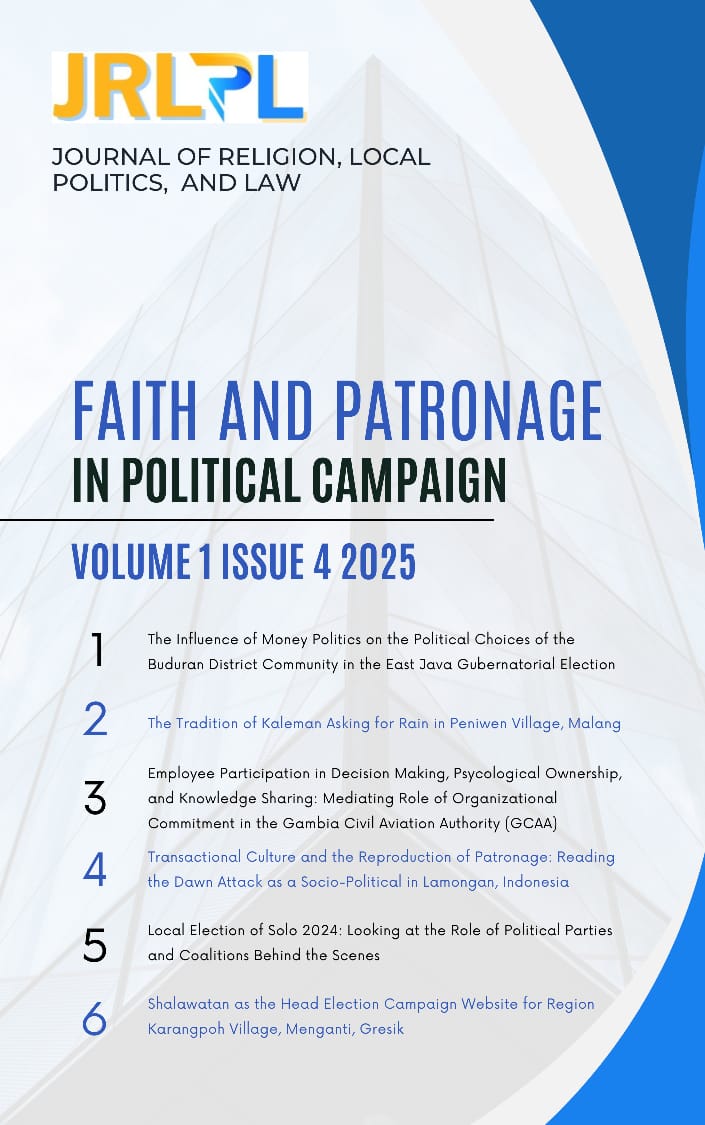
The Influence of Money Politics on the Political Choices of the Buduran District Community in the East Java Gubernatorial Election
Authors

DOI:
https://doi.org/10.64595/jrlpl.v1n4.p225-234Keywords:
Money Politics, Gubernatorial Election, Political ChoiceAbstract
In the context of the gubernatorial election in East Java, this study examines how the political choices of the public are influenced by money politics. Money politics in a democratic system often affects voters' decisions, raising concerns about the integrity and quality of the electoral process. This research employs a qualitative approach through in-depth interviews and surveys to explore how voters react to offers of money politics and the consequences for their attitudes and behaviors when casting their votes. The study finds that although many voters are aware of the negative impacts of money politics, many accept the proposals due to economic reasons and pressing needs. Furthermore, the practice of money-focused politics often diverts voters' attention from candidates' goals and visions to the financial incentives offered. The findings of this research emphasize that, to ensure fairer and higher-quality elections in the future, voter education and strengthened regulations are necessary to combat the practice of money politics.
Downloads
References
Abdurrohman. (2021). Dampak fenomena politik uang dalam Pemilu dan pemilihan [The impact of the phenomenon of money politics in elections and regional elections]. AWASIA: Jurnal Pemilu dan Demokrasi, 1(2), 142–159.
Adlin et al. (2022); Ardianto (2021); Aspinall et al. (2017); Mahsun et al. (2021); Mas'udi and Kurniawan (2017); Reuter (2015); Shin (2015); Simandjuntak (2012) and Tawakkal et al.
(2017).
Amal, I. (2022). Fenomena dan faktor penyebab masifnya praktik politik uang pada Pemilu di Provinsi Banten [Phenomena and factors causing the massive practice of money politics in elections in Banten Province]. Jurnal Politik dan Sosial Kemasyarakatan, 14(3), 592–606. Ardiani , D., Kartini, DS, & Herdiansyah , AG (2019). Socialization Strategy Politics By KPU Regency Ngawi To Form Voters Smart Beginner In Selection Governor and Deputy Governor of East Java 2018 in the Regency Ngawi . Socius Journal: Journal of Sociology
Research and Education, 6(1), 18-32.
Arianto, B. (2020). Money, politics, and their impact on voter behavior in Indonesia's regional elections. Journal of Political Science and Governance, 12(3), 145–160.
Aspinall, E., & Berenschot, W. (2019). Democracy for sale: Elections, clientelism, and the state in Indonesia. New York, Cornell University. This book explores the dynamics of elections, clientelism, and the state in Indonesia.
Aspinall, E., & Sukmajati, M. (2016). Electoral Dynamics in Indonesia: Money Politics, Patronage, and Clientelism at the Grassroots level. Fauzan Hidayat (2024), Money Politics in a Democratic Political System: A Case study of South Korea and European Countries.
Benigna, R. (2019). Communication Strategy Khofifah-Emil's Politics in the Election Governor of East Java 2018 (Doctoral dissertation, AIRLANGGA UNIVERSITY).
Fionna, U. (2017). Campaign Consultancy in the Batu (East Java) Local Election.
Hawing, H., & Hartaman , N. (2021). Money Politics in Democracy In Indonesia: Case Study of Regional Elections Regency Enrekang 2018. Journal of Social Politics and Governance (JSPG), 3(1), 45-53. DOI: https://doi.org/10.24076/JSPG.2021v3i1.533
Hidayat, T., & Suryanto, A. (2022). Election: Indonesia's case. Jurnal Hukum Novelty, 11(2), 124.
Komarudin (2024), Money Politics and Voter Behavior: Factors Behind Incumbent Defeat in Subang Regency's 2024 Regional Election. DOI: https://doi.org/10.26532/jh.v41i2.44163
Lampus , C. M., Lapian , M. T., & Sondakh , E. (2022). Phenomenon Money Politics in Legislative Elections 2019 In The District Wanea. Journal Executive , 2(3).
LPEM-FEUI shows that campaign costs for DPR candidates range from Rp. 1.18 billion to Rp.
4.6 billion, while costs for provincial DPRD candidates range from Rp. 320 million to Rp. 3 billion.
Muhtadi, M. (2019). Vote Buying in Indonesia: The Mechanics of Electoral Bribery. Noor, R. (2021). The Implementation of Direct Local Election (Pilkada) and Money Politics Tendencies: The Current Indonesian Case.
Muzakki , M., & Si, M. POLITICAL COMMUNICATION BIAS IN PUBLIC SPACE IN ELECTION AND REGIONAL ELECTIONS IN EAST JAVA.
Pahlevi, MET, & Amrurobbi , AA (2020). Political Education in Prevention Money Politics Through Village Community Movements. Integrity : Journal Anti-corruption , 6(1), 141- 152.
PROGRESSIVE STEPS IN PREVENTING AND HANDLING MONEY POLITICS IN INDONESIAN ELECTIONS: AN EFFORT TO REDUCE DEVIANT BEHAVIOR IN DEM (2023)
Rahmanda, NS (2017). Factors of Community Attitudes and Behavior Permissive to Practice Money Politics in Election of Candidate Members Bandar Lampung City Legislature 2014
Ramadhani, NC (2020). A LEGAL SOCIOLOGICAL REVIEW OF THE PERCEPTION OF PROSPECTIVE BEGINNER VOTERS TOWARDS MONEY POLITICS IN YOGYAKARTA CITY.
Rozy, F., Ramadhan, PA, Febriansyah , R., Fahrurozi , F.A., Rizky, A.I., & Fauzi, AM (2020). Practice Money Politics in the Election Process, Head of Sumberingin Kidul Village in 2019. Socius Journal: Journal of Sociology Research and Education, 7(1), 37-44. DOI: https://doi.org/10.24036/scs.v7i1.171
Sari, M. M. K., Huda, M., & Warsono, W. (2023). University student voters' resistance to money politics. Integritas: Jurnal Antikorupsi, 9(1) DOI: https://doi.org/10.32697/integritas.v9i1.988
Septiadi, M. A., Salsabilla, A., Bernadib, B., & Nugraha, L. (2021). The Imperative Power of Election Law on Money Politics. Soshum: Jurnal Sosial Dan Humaniora, 11(2), 112–119. DOI: https://doi.org/10.31940/soshum.v11i2.2480
Susanti, R. (2021). Money politics in election reviewed from perspective legal sociological . Lex Renaissance, 6(3), 578-590.
Sutrisno, E., & Prasetyo, B. (2021). Pengaruh politik uang terhadap kualitas demokrasi di Indonesia
Amal, I. (2022). Fenomena dan faktor penyebab masifnya politik uang di Pemilu Banten. Jurnal Politik dan Sosial Kemasyarakatan, 14(3), 592–606. DOI: https://doi.org/10.52166/madani.v14i03.3824
Arianto, B. (2020). Money, politics, and their impact on voter behavior in Indonesia’s regional
elections. Journal of Political Science and Governance, 12(3), 145–160.*
Aspinall, E., & Berenschot, W. (2019). Democracy for sale: Elections, clientelism, and the state in Indonesia. Cornell University Press. DOI: https://doi.org/10.7591/9781501732997
Aspinall, E., & Sukmajati, M. (Eds.). (2016). Electoral dynamics in Indonesia: Money politics,
patronage, and clientelism at the grassroots. NUS Press.
Aspinall, E., Warburton, E., & Panggabean, R. (2020). Brokered citizenship in Indonesia. Critical Asian Studies, 52(3), 357–375.*
Berenschot, W. (2018). The political economy of clientelism: A comparative study of Indonesia. DOI: https://doi.org/10.1177/0010414018758756
Routledge.
Bourdieu, P. (1977). Outline of a theory of practice. Cambridge University Press. Bourdieu, P. (1991). Language and symbolic power. Harvard University Press.
Braun, V., & Clarke, V. (2006). Using thematic analysis in psychology. Qualitative Research in Psychology, 3(2), 77–101.* DOI: https://doi.org/10.1191/1478088706qp063oa
Creswell, J. W., & Poth, C. N. (2018). Qualitative inquiry and research design: Choosing among five approaches (4th ed.). SAGE.
Crouch, H. (2010). Political reform in Indonesia after Soeharto. ISEAS. DOI: https://doi.org/10.1355/9789812309211
Denzin, N. K., & Lincoln, Y. S. (Eds.). (2018). The SAGE handbook of qualitative research (5th ed.). SAGE.
Fionna, U. (2017). Campaign consultancy and local politics in East Java. Journal of Asian and African Studies, 52(3), 391–405.*
Flick, U. (2014). An introduction to qualitative research (5th ed.). SAGE.
Hadiz, V. R. (2017). Islamic populism in Indonesia and the Middle East. Cambridge University Press. DOI: https://doi.org/10.4324/9781315628837-24
Hadiz, V. R., & Robison, R. (2017). The political economy of oligarchy and the reorganization of power in Indonesia. Routledge.
Hicken, A. (2011). Clientelism. Annual Review of Political Science, 14(1), 289–310.* DOI: https://doi.org/10.1146/annurev.polisci.031908.220508
Kitschelt, H., & Wilkinson, S. I. (Eds.). (2007). Patrons, clients, and policies: Patterns of democratic accountability and political competition. Cambridge University Press. DOI: https://doi.org/10.1017/CBO9780511585869
Lincoln, Y. S., & Guba, E. G. (1985). Naturalistic inquiry. SAGE. DOI: https://doi.org/10.1016/0147-1767(85)90062-8
Muhtadi, B. (2019). Vote buying in Indonesia: The mechanics of electoral bribery. Palgrave Macmillan. DOI: https://doi.org/10.1007/978-981-13-6779-3
Noor, M. (2021). Patronage and money politics in Indonesia’s decentralization era. Contemporary Southeast Asia, 43(2), 231–250.*
Nugroho, H. (2021). Political dependency and informal networks in Indonesia’s local democracy.
Asian Journal of Political Science, 29(1), 45–61.*
Ong, A. (2018). Flexibility and situational ethics in Southeast Asia’s democracies. Stanford University Press.
Palinkas, L. A., Horwitz, S. M., Green, C. A., Wisdom, J. P., Duan, N., & Hoagwood, K. (2015). Purposeful sampling for qualitative data collection and analysis in mixed-method implementation research. Administration and Policy in Mental Health and Mental Health Services Research, 42(5), 533–544.* DOI: https://doi.org/10.1007/s10488-013-0528-y
Putnam, R. D. (2000). Bowling alone: The collapse and revival of American community. Simon & Schuster. DOI: https://doi.org/10.1145/358916.361990
Scott, J. C. (1976). The moral economy of the peasant: Rebellion and subsistence in Southeast Asia. Yale University Press.
Scott, J. C. (1985). Weapons of the weak: Everyday forms of peasant resistance. Yale University Press.
Sidel, J. (2015). Capital, coercion, and crime: Bossism in the Philippines. Stanford University Press.
Walker, A. (2012). Thailand’s political peasants: Power in the modern rural economy. University of Wisconsin Press. DOI: https://doi.org/10.2307/jj.36075996
Warburton, E., & Aspinall, E. (2019). Explaining Indonesia’s democratic regression: Structure,
agency and populism. Pacific Affairs, 92(3), 367–390.*
Yin, R. K. (2018). Case study research and applications: Design and methods (6th ed.). SAGE. Ziegenhain, P. (2020). Democracy and corruption in Southeast Asia. Springer
Downloads
Published
Issue
Section
License
Copyright (c) 2025 Nesta Imanuel Christian (Author); Jhezkiel Enrico Laksmana (Translator)

This work is licensed under a Creative Commons Attribution-ShareAlike 4.0 International License.