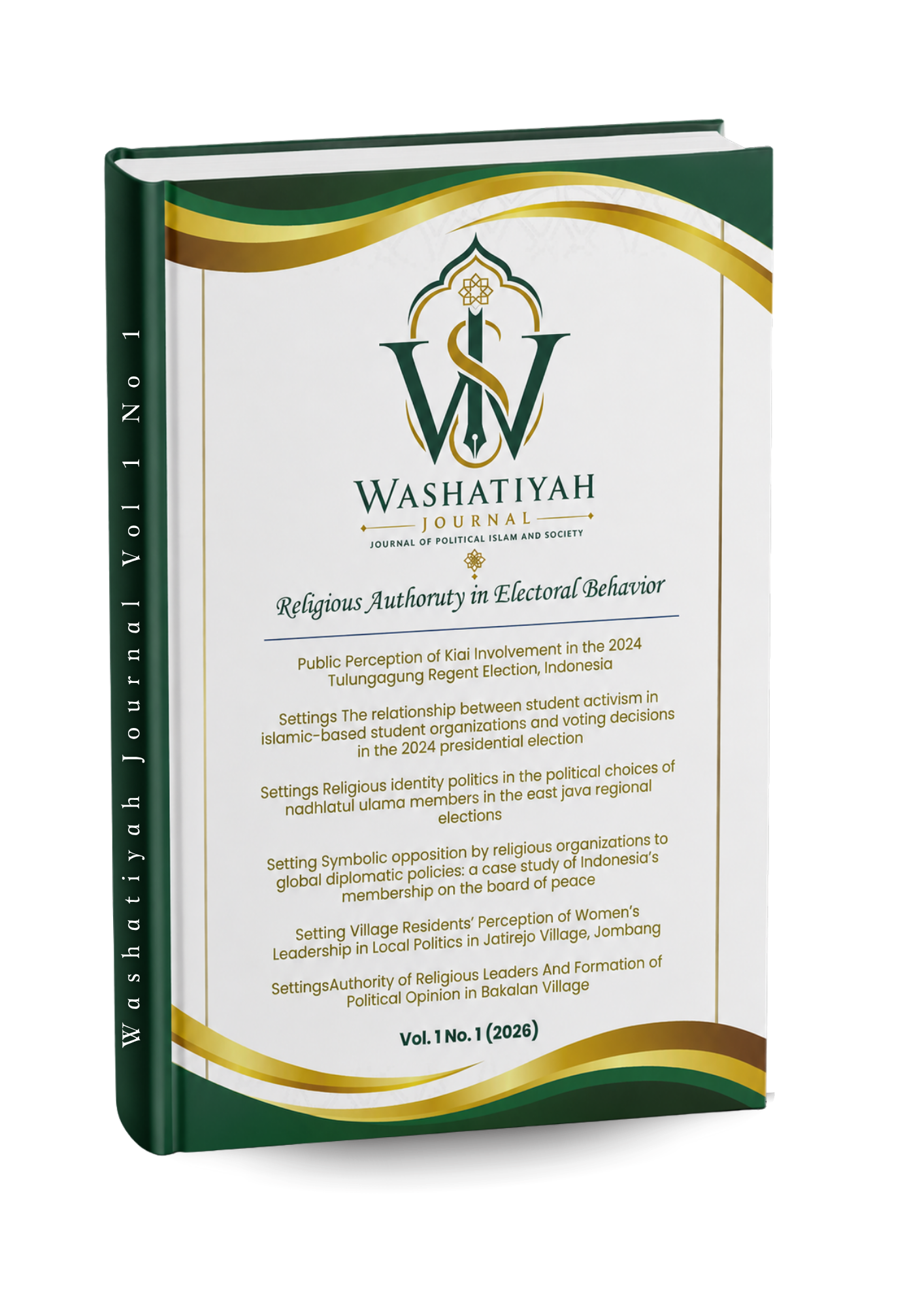
Public Perception of Kiai Involvement in the 2024 Tulungagung Regent Election, Indonesia
Authors
-
Haniefa Auliya Rahmah
 State University of Surabaya, Surabaya, Indonesia
-
Nik Nur Nazira Arisya Bt Nik Nazman
 State Universiti Sultan Zainal Abidin – UniSZA, Kuala Terengganu, Malaysia
DOI:
https://doi.org/10.64595/wasathiyah.v1n1.p1-13Keywords:
Kiai\, Political Participation, Public ParticipationAbstract
This study examines public perceptions of kiai involvement in the 2024 Tulungagung Deputy Regent election within the context of local political dynamics. The research aims to understand how society interprets the role of religious leaders in practical politics. Using a qualitative descriptive approach, data were collected through in-depth interviews, observation, and documentation involving community members familiar with the political process. The findings reveal that public perceptions are divided. On the one hand, kiai are viewed as moral authorities who can provide ethical guidance and legitimacy to political actors. On the other hand, their involvement in practical politics, particularly in controversial campaign activities and programs, has generated criticism and led to a decline in perceived moral authority among some segments of society. The analysis shows that these perceptions are socially constructed through ongoing interactions and are increasingly influenced by digital media, which accelerates the dissemination and reinterpretation of kiai’s public image. Furthermore, the study finds a shift in the nature of kiai influence, from dominant moral authority toward a more negotiated and contested position. The implications of this research suggest that the involvement of religious leaders in politics must be carefully managed to maintain public trust, as their legitimacy is no longer solely based on traditional authority but also on public perception shaped in both offline and online spaces
Downloads
References
Agustina, C. M., Yazwardi, Y., & Mikail, K. (2022). Manifestasi Kepentingan Politik JKSN Sumsel Terhadap Paslon Jokowi-Ma’ruf dalam Pilpres 2019. Ampera: A Research Journal on Politics and Islamic Civilization, 3(02), 130–137. https://doi.org/10.19109/ampera.v3i02.11844 DOI: https://doi.org/10.19109/ampera.v3i02.11844
Azharghany, R., Adim, A., & Rusdi, H. R. (2022). Paradigma Dakwah Islam Kyai dalam Kancah Politik Kekuasaan Pasca Kemerdekaan di Indonesia. Alhadharah: Jurnal Ilmu Dakwah, 21(2), 1. https://doi.org/10.18592/alhadharah.v21i2.7184 DOI: https://doi.org/10.18592/alhadharah.v21i2.7184
Baihaqi, B., Tutik, T. T., Musadad, A., Khazin, A. M., & Simun, M. G. B. (2024). Legal Non-Compliance and Kiai Hegemony: The Practice of Unregistered Marriages among the Madurese Muslim Community of Kubu Raya. Journal of Islamic Law, 5(2), 242–268. https://doi.org/10.24260/jil.v5i2.2819 DOI: https://doi.org/10.24260/jil.v5i2.2819
Chalik, A., & Hamdi, A. Z. (2022). New Trajectory of Kyai’s Political Participation in Contemporary Indonesia: Rises, Challenges, and Opportunities. Indonesian Journal of Political Studies (IJPS), 2(2), 131–152. https://doi.org/10.15642/ijps.2022.2.2.131-152 DOI: https://doi.org/10.15642/ijps.2022.2.2.131-152
Fahmy, M. F. A., Muis, A., & Abidin, Z. (2024). From Religious Authority to Economic Actor: Exploring the Kiai’s Strategic Role in the Economic Empowerment of Pesantren Communities. Fenomena, 23(2), 209–222. https://doi.org/10.35719/fenomena.v23i2.599 DOI: https://doi.org/10.35719/fenomena.v23i2.599
Fikri, S. A., Muhtadi, A. S., & Ma’arif, B. S. (2024). Kiai dan Komunikasi Politik Praktis di Pondok Buntet Pesantren Cirebon. Jurnal Perspektif, 8(2), 172. https://doi.org/10.15575/jp.v8i2.297 DOI: https://doi.org/10.15575/jp.v8i2.297
Hannan, A. (2023). The Political Ethics of Kiai. Sophist : Jurnal Sosial Politik Kajian Islam Dan Tafsir, 5(2), 236–275. https://doi.org/10.20414/sophist.v5i2.94 DOI: https://doi.org/10.20414/sophist.v5i2.94
I Gusti Agung Ayu Rinka Sari & Gede Crisna Wijaya. (2024). PENDIDIKAN POLITIK MENJELANG PEMILIHAN UMUM 2024 PADA GENERASI MUDA DI DESA PEDUNGAN. Diseminasi: Jurnal Pengabdian Kepada Masyarakat, 6(1), 141–148. https://doi.org/10.33830/diseminasiabdimas.v6i1.7680 DOI: https://doi.org/10.33830/diseminasiabdimas.v6i1.7680
Istianah, R. & Saehudin. (2023). POLITIK IDENTITAS DAN PERILAKU POLITIK KIAI DI KOTA SUKABUMI MENJELANG PEMILIHAN UMUM 2024. Electoral Governance Jurnal Tata Kelola Pemilu Indonesia, 4(2), 233–250. https://doi.org/10.46874/tkp.v4i2.876 DOI: https://doi.org/10.46874/tkp.v4i2.876
Junaedi, E., Kiram, S., & Fahkrurrazi. (2025). The Phenomenon of Religious Figures Involvement in Practical Politics: Analysis of the Role and Public Perception in the 2024 Election. Jurnal Tapis: Jurnal Teropong Aspirasi Politik Islam, 21(1), 184–210. https://doi.org/10.24042/xq3xjb60 DOI: https://doi.org/10.24042/xq3xjb60
Kiptiyah, P., & Kamila, A. N. S. (2025). The Sholawat as A Form of Social Capital in The Political Contestation of Kediri Regency, Indonesia. Journal of Southern Sociological Studies, 1(2), 131–149. https://doi.org/10.26740/jsss.v1i2.42463 DOI: https://doi.org/10.26740/jsss.v1i2.42463
Mahyudin, M. A. A. (2024). The Declining Role of Islamic Politics and The Jokowi’s Factors in the 2024 Presidential Election: A Study of Contemporary Political Policies and Dynamics in Indonesia: A Study of Contemporary Political Policies and Dynamics in Indonesia. Religion and Policy Journal, 2(1), 1–9. https://doi.org/10.15575/rpj.v2i1.746 DOI: https://doi.org/10.15575/rpj.v2i1.746
Maram, A. N., Busyairi, A., & Assidiqi, M. R. (2023). Decline of Ideology and Rise of Political Pragmatism Among Kiai in Post-Authoritarian Indonesia. An-Nur International Journal of Islamic Thought, 1(1), 1–15. https://doi.org/10.62032/aijit.v1i1.15 DOI: https://doi.org/10.62032/aijit.v1i1.15
Mutiullah, M. Y. N. (2024). Religion and Politics in Indonesia: The Role of Kyai in the 2024 Election, Case Study on Partai Kebangkitan Bangsa (PKB). Afkaruna: Indonesian Interdisciplinary Journal of Islamic Studies, 20(1). https://doi.org/10.18196/afkaruna.v20i1.18527 DOI: https://doi.org/10.18196/afkaruna.v20i1.18527
Paputungan, D. Y., Hatu, R. A., & Hatu, D. R. (2025). Dampak Perbedaan Pilihan Politik Pilkada terhadap Hubungan Masyarakat dan Pemerintah Desa Mooat. RIGGS: Journal of Artificial Intelligence and Digital Business, 4(4), 2766–2776. https://doi.org/10.31004/riggs.v4i4.3765 DOI: https://doi.org/10.31004/riggs.v4i4.3765
Putro, S., Risdiana, A., Jihan Fitri, F. Z., & Harminingsih, H. (2022). Is Kiai a Transformational Leadership Model? Jurnal Pemberdayaan Masyarakat: Media Pemikiran Dan Dakwah Pembangunan, 6(2), 137–154. https://doi.org/10.14421/jpm.2022.062-01 DOI: https://doi.org/10.14421/jpm.2022.062-01
Rohman, A. (2023). Religious Leadership and Political Triumph: A Case Study of Kiai and Santri Strategies in the 2018 Pamekasan Local Elections. Jurnal Mengkaji Indonesia, 2(2), 407–427. https://doi.org/10.59066/jmi.v2i2.560 DOI: https://doi.org/10.59066/jmi.v2i2.560
Sembiring, W. M., Saraan, M. I. K., Rozi, F., & Nurasiah. (2024). A Thematic Study of the Quran and Hadith on the Election of Leaders: A Case Study of Presidential Elections in Indonesia in 2024. Pharos Journal of Theology, (105(2)). https://doi.org/10.46222/pharosjot.105.26 DOI: https://doi.org/10.46222/pharosjot.105.26
Silitonga, M. G., Muliono, M., & Muhammad, H. A. (2025). Conflict and politicized religion: The case of a study on electoral democracy in Jambi Province. Priviet Social Sciences Journal, 5(12), 628–637. https://doi.org/10.55942/pssj.v5i12.1069 DOI: https://doi.org/10.55942/pssj.v5i12.1069
Syamsiar, H., Latif, A., & Abdurrohman, A. (2025). Persepsi Masyarakat terhadap Calon Kepala Daerah Perempuan (Perspektif Sosiologi Gender dalam Pilkada NTB 2024). Jurnal Humanitas: Katalisator Perubahan Dan Inovator Pendidikan, 11(2), 328–344. https://doi.org/10.29408/jhm.v11i2.30408 DOI: https://doi.org/10.29408/jhm.v11i2.30408
Syarif, Z., & Hannan, A. (2025). Exploring the Existence and Social Role of Kiai in the Dynamics of Politics and Democratization in Indonesia. Social Science and Humanities Journal, 9(01), 6372–6383. https://doi.org/10.18535/sshj.v9i01.1562 DOI: https://doi.org/10.18535/sshj.v9i01.1562
Topan, A., & Hakim, A. (2023). The Role of Local Religious Figures (Kiai) in Strengthening Political Participation in Post-new Order Madura 1998-2019. NAHNU: Journal of Nahdlatul Ulama and Contemporary Islamic Studies, 1(1), 21–40. https://doi.org/10.63875/nahnu.v1i1.22 DOI: https://doi.org/10.63875/nahnu.v1i1.22
Umam, A. K. (2024). Shadows of political corruption amidst the trend of declining democracy in Indonesia: Learning from the dynamics of 2024 Presidential Election. Integritas : Jurnal Antikorupsi, 10(1), 1–16. https://doi.org/10.32697/integritas.v10i1.1226 DOI: https://doi.org/10.32697/integritas.v10i1.1226
Wijaya, M. M. & Nurchamidah. (2025). Kiai’s National Politics in developing Moderate Santri. Indonesian Journal of Islamic Religious Education, 2(1), 11–24. https://doi.org/10.63243/d0e8cz40 DOI: https://doi.org/10.63243/d0e8cz40
Yani, M. T., Mahfud, C., Rangga Sa’adillah, S. A. P., Bustami, M. R., Maskuri, & Taufiq, A. (2022). Advancing the discourse of Muslim politics in Indonesia: A study on political orientation of Kiai as religious elites in Nahdlatul Ulama. Heliyon, 8(12), e12218. https://doi.org/10.1016/j.heliyon.2022.e12218 DOI: https://doi.org/10.1016/j.heliyon.2022.e12218
Zahro, F., & Saputri, F. I. (2024). Polarisasi Politik di Lingkungan Pondok Pesantren dalam Pemilihan Umum 2024. Manabia: Journal of Constitutional Law, 4(01), 21–36. https://doi.org/10.28918/manabia.v4i01.8663 DOI: https://doi.org/10.28918/manabia.v4i01.8663
Zain, W. K., Widiyastuti, I., Abidin, Z., Purwanto, E., & Hotifah, Y. (2025). Pengaruh Kepemimpinan Demokratis Kyai dan Self Efficacy Terhadap Intensi Berwirausaha Santri Pondok Pesantren Nurul Amanah Bangkalan. Sanskara Ilmu Sosial Dan Humaniora, 3(01), 78–87. https://doi.org/10.58812/sish.v3i01.689 DOI: https://doi.org/10.58812/sish.v3i01.689
Zainuddin, Z., Nafisah, A., Mustafiyanti, M., & Davik, D. (2026). Pesantren and the Political Authority of Kiai: The Dialectic of Religion, Power, and Education. Tafkir: Interdisciplinary Journal of Islamic Education, 7(2). https://doi.org/10.31538/tijie.v7i2.2115 DOI: https://doi.org/10.31538/tijie.v7i2.2115