Calystium: A Disability Empowerment Model Through an Eggshell WasteBased Craft Ecosystem and Inclusive Cafe Collaboration
Authors
-
Adelia ayu agustina
 Universitas Negeri Surabaya
-
Tasya Dwi Alfiatus Sa’diyah
Universitas Negeri Surabaya
-
Vanesa Ivon Amalia
Universitas Negeri Surabaya
-
Juliana Bulan Pertiwi
Universitas Negeri Surabaya
-
Catherine Mareta
Universitas Negeri Surabaya
-
Joan Hesti Gita Purwasih
 University of Science Malaysia
Keywords:
Disabilities, Inclusive Economy, Circular Economy, Social Enterprise, Business PlanAbstract
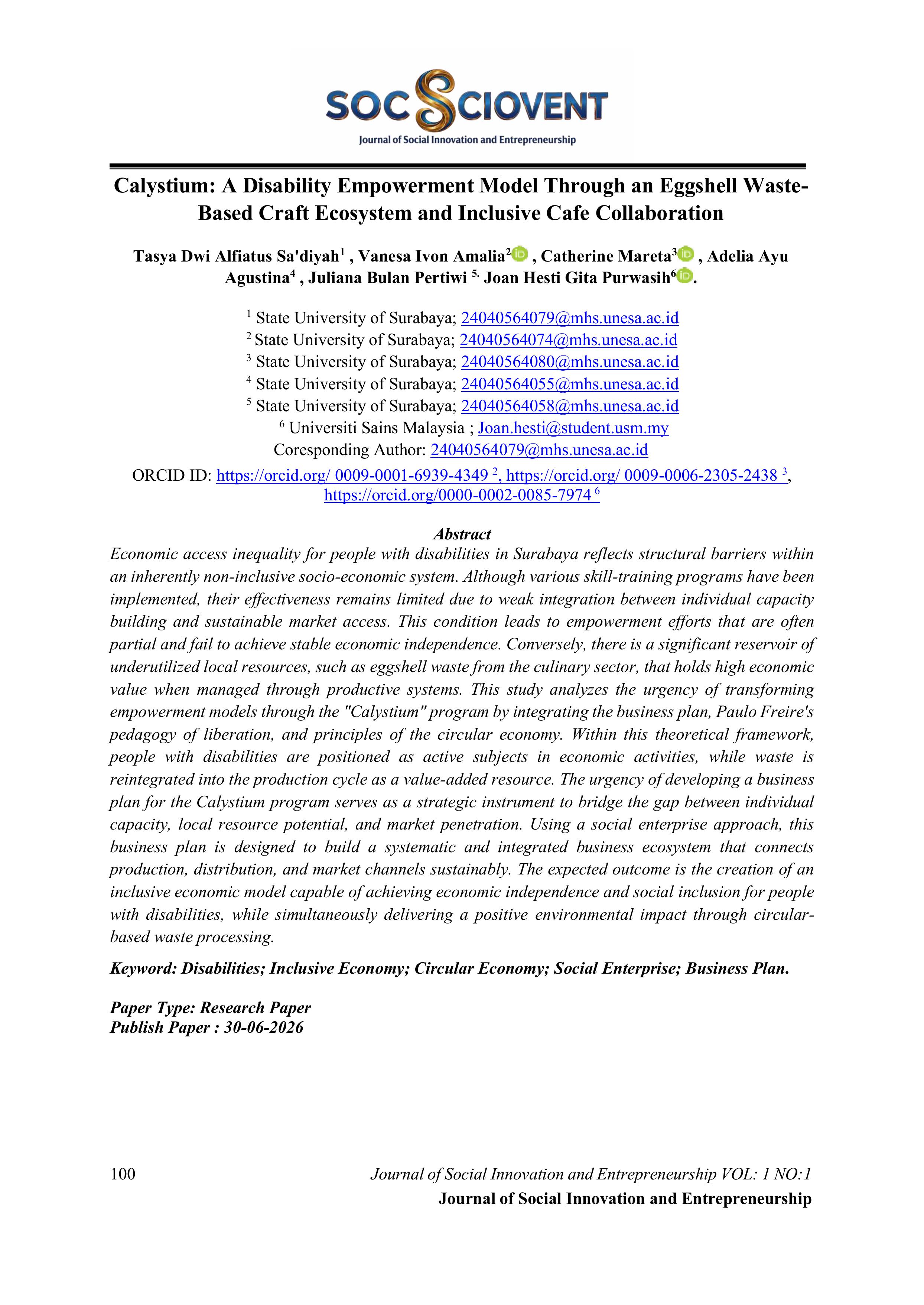
Economic access inequality for people with disabilities in Surabaya reflects structural barriers within an inherently non-inclusive socio-economic system. Although various skill-training programs have been implemented, their effectiveness remains limited due to weak integration between individual capacity building and sustainable market access. This condition leads to empowerment efforts that are often partial and fail to achieve stable economic independence. Conversely, there is a significant reservoir of underutilized local resources, such as eggshell waste from the culinary sector, that holds high economic value when managed through productive systems. This study analyzes the urgency of transforming empowerment models through the "Calystium" program by integrating the business plan, Paulo Freire's pedagogy of liberation, and principles of the circular economy. Within this theoretical framework, people with disabilities are positioned as active subjects in economic activities, while waste is reintegrated into the production cycle as a value-added resource. The urgency of developing a business plan for the Calystium program serves as a strategic instrument to bridge the gap between individual capacity, local resource potential, and market penetration. Using a social enterprise approach, this business plan is designed to build a systematic and integrated business ecosystem that connects production, distribution, and market channels sustainably. The expected outcome is the creation of an inclusive economic model capable of achieving economic independence and social inclusion for people with disabilities, while simultaneously delivering a positive environmental impact through circularbased waste processing.
Downloads
Downloads
Published
Issue
Section
License
Copyright (c) 2026 Adelia ayu agustina, Tasya Dwi Alfiatus Sa’diyah, Vanesa Ivon Amalia, Juliana Bulan Pertiwi, Catherine Mareta, Joan Hesti Gita Purwasih (Author)

This work is licensed under a Creative Commons Attribution-NonCommercial 4.0 International License.